
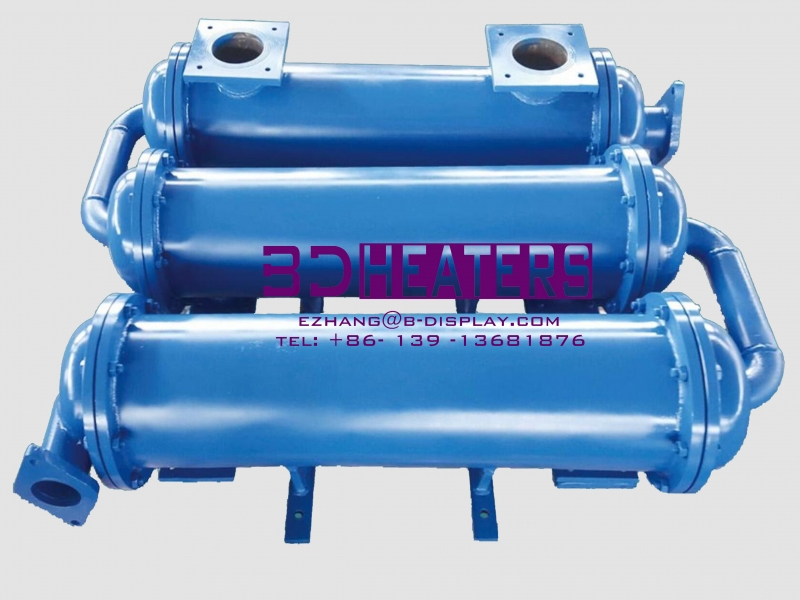
| Name: | Heater Exchanger 002 |
|---|---|
| Condition: | New |
| Place of Origin: | Jiangsu, China |
| Dimension(LWH): | Customized |
| Working Voltage: | 110V/230V/240V/380V/440V/480V |
| Temperature Range: | 1 - 800 ℃ |
| Key Selling Points: | High-Accuracy |
| Package: | Carton+Wooden case |
| Lead Time: | 5 days |
| Supply Ability: | 1000 Pieces per Month |
| Inquiry |
Product Description
The heat exchanger is a heat exchange equipment that transfers the heat of the hot fluid to the cold fluid to make the fluid temperature reach the specified indicators of the process flow. There are many types of heat exchangers. However, according to the principle and mode of heat exchange of the cold and hot fluid, it can be basically divided into three categories: inter wall type, mixed type, and heat storage type. Among the three types of heat exchangers, the wall type heat exchanger is the most widely used. Heat exchanger is a general equipment in chemical, petroleum, power, food, and many other industrial sectors, and plays an important role in production. In chemical production, heat exchangers can be used as heaters, coolers, condensers, evaporators and reboilers, and are more widely used. Heat exchanger is a kind of unit equipment, such as heater, cooler, condenser, etc. It is also a component of a process equipment, such as the heat exchanger in the ammonia converter. Therefore, heat exchanger is an important unit equipment in chemical production.
At present, remarkable achievements have been made in domestic research on improving the performance of heat exchanger, improving heat transfer efficiency, reducing heat transfer area, reducing pressure drop, and improving the heat intensity of the device in terms of energy conservation and efficiency enhancement. The extensive use of heat exchanger effectively improves the utilization rate of energy, reduces the cost of enterprises, and improves the efficiency.
Structure:
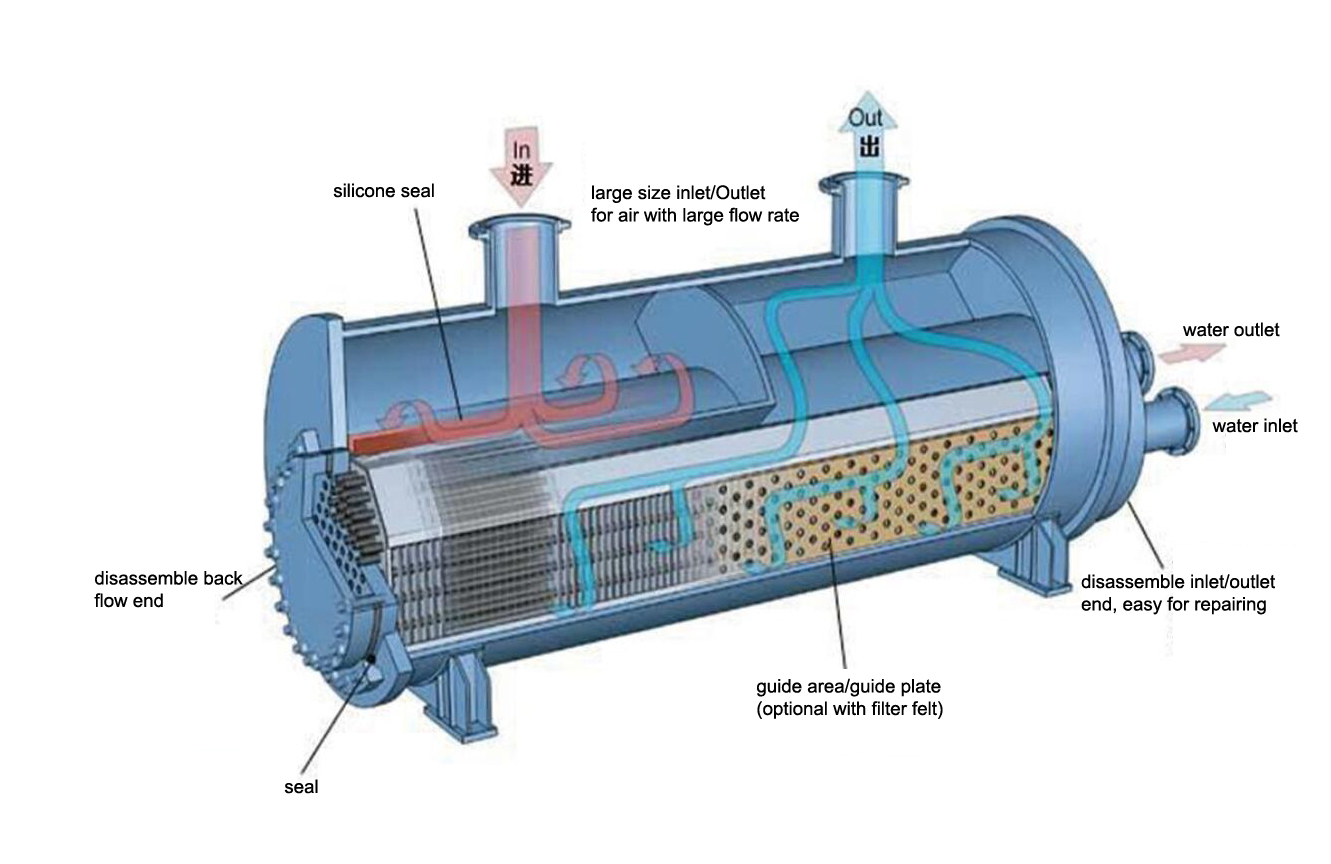
Tubular heat exchanger is simple, compact, and cheap, but it cannot be mechanically cleaned outside the tube. The tube bundle of the heat exchanger is connected to the tube sheet, which is welded to both ends of the shell respectively, and connected with a top cover which is equipped with a fluid inlet and outlet pipe. Usually, a series of baffles perpendicular to the tube bundle are installed outside the tube. At the same time, the connection between the tube and the tube sheet and the shell is rigid, while inside and outside the tube are two fluids with different temperatures. Therefore, when the temperature difference between the tube wall and the shell wall is large, due to the different thermal expansion of the two, a large temperature difference stress is generated, so that the tube is twisted or loosened from the tube sheet, or even the heat exchanger is damaged.
In order to overcome the temperature difference stress, a temperature difference compensation device must be provided. Generally, when the temperature difference between the pipe wall and the shell wall is more than 50 ° C, the heat exchanger should have a temperature difference compensation device for safety. However, the compensation device (expansion joint) can only be used when the temperature difference between the shell wall and the pipe wall is less than 60~70 ° C and the fluid pressure on the shell side is not high. Generally, when the shell side pressure exceeds 0.6Mpa, due to the thickness of the compensation ring, it is difficult to expand and contract, and the effect of temperature difference compensation is lost, other structures should be considered.

 Send Email
 WhatsApp
 QR Code